You ensure a forklift operator’s safety through four things working together: proper training and certification, a thorough inspection before every shift, safe operating habits (seatbelt on, loads low, speed down), and a workplace designed to keep pedestrians and trucks apart, with warning lights, marked aisles and clear rules. Most forklift accidents trace back to a gap in one of those areas, and almost all of them are preventable.
This guide covers what US employers are required to do under OSHA rules, what operators can do every day, and how equipment such as blue safety lights and well-maintained parts reduce risk.
Why forklift safety deserves serious attention
A forklift is a powered industrial truck with two forks at the front for lifting and moving pallets and heavy loads. Common types include counterbalance trucks powered by electric batteries, propane or diesel, as well as reach trucks, order pickers and rough-terrain models. They are compact but heavy, often weighing several times more than a car, and their rear-wheel steering and raised loads make them handle very differently from a road vehicle.
That combination is why the most serious incidents are tip-overs, operators being crushed, pedestrians being struck, and falling loads. Near-misses are far more common and are an early warning that something in the system needs fixing.
Training and certification requirements
In the US, OSHA’s powered industrial truck standard (29 CFR 1910.178) requires employers to make sure every operator is trained and evaluated before driving a forklift at work. Key points include:
- Formal instruction and hands-on practice: training must combine classroom-style learning with practical driving, under the supervision of a qualified trainer.
- Truck- and site-specific content: operators must learn the specific types of trucks they will use and the conditions of the workplace, such as ramps, surfaces and pedestrian areas.
- Performance evaluation: an evaluator must watch the operator work before they are certified.
- Re-evaluation at least every three years, and refresher training after an accident or near-miss, unsafe driving, a change of truck type or a change in workplace conditions.
- Minimum age: federal child labor rules generally bar workers under 18 from operating forklifts in nonagricultural jobs.
A card from an online course alone does not meet the requirement; the employer is responsible for the practical evaluation on its own equipment.
The pre-shift inspection checklist
OSHA requires trucks to be examined before being placed in service, at least daily, and more often for trucks used around the clock. A quick, consistent routine catches most problems before they cause harm.
| Check | What to look for |
|---|---|
| Forks and mast | Cracks, bends, uneven fork tips, damaged chains, worn rollers |
| Tires | Cuts, chunks missing, low pressure on pneumatic tires |
| Fluids | Hydraulic, engine oil, coolant levels; any leaks under the truck |
| Power source | Battery charge and cable condition, or propane tank secure with no leaks |
| Controls | Steering, brakes, parking brake, lift and tilt working smoothly |
| Safety devices | Horn, lights, backup alarm, seatbelt, overhead guard, load backrest |
| Data plate | Present and readable, showing rated capacity |
Any truck with a defect that affects safe operation must be taken out of service until it is repaired. Tag it clearly and report it.
Maintenance and replacement parts
Regular preventive maintenance, based on the manufacturer’s schedule and hours of use, keeps brakes, hydraulics and steering reliable. Keeping common wear items on hand, such as tires, filters, chains and light assemblies, reduces downtime and removes the temptation to keep a faulty truck running “just for today.” Use parts that meet the manufacturer’s specifications; modifications that affect capacity or safe operation need the manufacturer’s written approval under OSHA rules.
Safe operating habits for every shift
- Wear the seatbelt. In a tip-over, the belt keeps you inside the protective overhead guard.
- Know the capacity. Never exceed the rated load on the data plate, and remember capacity drops as the load center moves forward or the mast goes higher.
- Travel with forks low, a few inches off the floor and tilted back, and never raise or lower a load while moving.
- Keep speed down, especially on turns, wet floors and uneven surfaces. Sharp turns at speed are a common cause of tip-overs.
- Drive in reverse when a load blocks your view, and use a spotter when needed.
- On ramps, keep the load pointed uphill when loaded and never turn on a slope.
- Never carry passengers or lift people on the forks unless using an approved work platform.
- Park safely: forks fully lowered, controls neutral, parking brake set, and power off if you leave the truck.
Handling loads correctly
Many incidents start with the load rather than the driving. Before lifting, check that the pallet is sound and the load is stable, square and centered on the forks. Spread the forks as wide as the pallet allows, drive them fully under the load, and tilt the mast back slightly before lifting. Wrap or band loose items so nothing can slide off. When stacking on racks, stop squarely in front of the bay, raise the load only when the truck is stationary, and watch for overhead obstructions such as sprinklers, lights and beams. If a load blocks your view or feels unstable, stop and rearrange it rather than pressing on. You might also like 17th Edition Safety Regulations and the Issues They Raise.
If the truck starts to tip
For a sit-down counterbalance forklift, the standard advice is: do not jump. Stay in the seat with your belt on, hold the steering wheel firmly, brace your feet, and lean away from the direction of the fall. Many fatal injuries happen when an operator tries to leap clear and is caught under the overhead guard.
Protecting pedestrians and coworkers
Operators are only half of the picture. People on foot in warehouses, loading docks and retail backrooms are at real risk, especially at blind corners and rack ends. Good site design helps everyone:
- Mark separate pedestrian walkways and forklift lanes with floor paint or barriers.
- Install convex mirrors at blind intersections.
- Set speed limits and enforce horn use at corners and doorways.
- Require high-visibility clothing in shared areas.
- Keep aisles clear of stored materials and spills.
Warning lights: blue spots and red zones
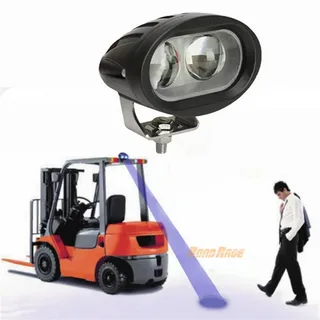
Backup alarms can blend into the background noise of a busy warehouse. Projected floor lights add a visual warning that people notice even when they cannot hear a truck. A blue spotlight, mounted to shine a bright dot several feet ahead of or behind the forklift, signals that a truck is approaching before it appears around a corner. Red “zone” lights project a line along the sides of the truck to show the area pedestrians should stay out of. Suppliers of blue light forklift safety equipment offer both types, and many facilities fit them to every truck that works near foot traffic. Lights are a supplement to training and layout, not a replacement.
Loading docks, trailers and charging areas
- Docks: keep a safe distance from dock edges, and make sure trailers are secured with wheel chocks or a vehicle restraint before driving in.
- Trailers: check the trailer floor for damage and use dock plates rated for the combined weight of the truck and load.
- Battery charging: charge in a designated, ventilated area, wear eye and face protection when handling batteries, and keep an eyewash station nearby.
- Propane: change tanks outdoors or in a well-ventilated area, away from ignition sources, wearing gloves.
Building a safety culture
Rules work best when people follow them because they believe in them, not because someone is watching. Encourage operators to report near-misses without fear of blame, review incidents to find root causes, and involve experienced drivers in training new ones. Short weekly toolbox talks keep safety top of mind. Engaged teams tend to look out for each other, and our guide on how to keep employees engaged at work offers practical ideas. Efficient warehouse layout also cuts unnecessary truck movements; see our article on smart logistics strategies for more.
This article is general information, not legal or compliance advice. Check current OSHA requirements and your equipment manufacturer’s guidance for your specific operation.
Frequently asked questions
How often do forklift operators need to be recertified?
Under OSHA rules, operators must be re-evaluated at least every three years, and sooner after an accident, near-miss, unsafe operation or a change in truck type or workplace conditions.
How often should a forklift be inspected?
Forklifts must be examined before being placed in service, at least daily, and after each shift when they are used around the clock.
What does a blue light on a forklift mean?
A blue spotlight projects a bright dot on the floor ahead of or behind the truck to warn pedestrians that a forklift is approaching, even around corners or in noisy areas.
Should you jump off a tipping forklift?
No. On a sit-down forklift, stay in the seat with your seatbelt on, grip the wheel, brace your feet and lean away from the fall.
What is the most common cause of forklift accidents?
Common causes include inadequate training, speeding or sharp turns, overloaded or unstable loads, poor visibility and pedestrians sharing space with trucks without clear separation.