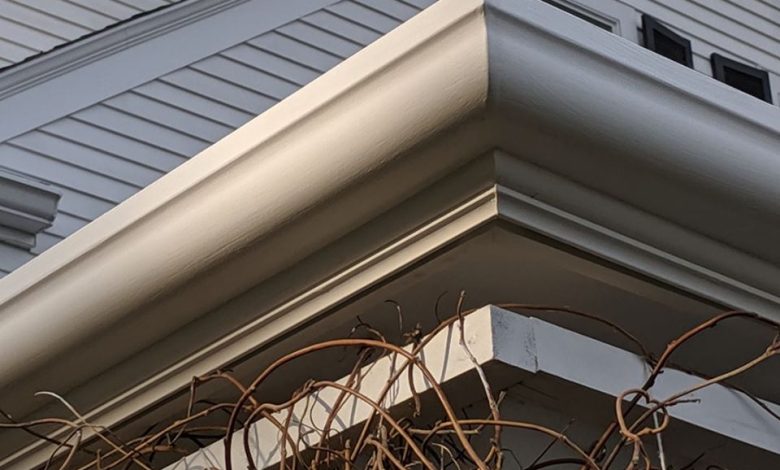
Eavestrough repair means fixing the gutters that run along your roof edge so they catch rain and snowmelt and carry it away from the house. Most problems, such as clogs, small leaks at seams, loose hangers and sagging runs, can be fixed in an afternoon for the cost of sealant and a few brackets. Widespread rust, repeated leaks or badly bent sections usually mean it is time to replace a run instead. This guide explains how to diagnose the problem, what you can fix yourself, typical costs, and when to call a pro.
What eavestroughs do and why repairs matter
“Eavestrough” is the term widely used in Canada and parts of the northern US for what most Americans call rain gutters. The system has three main parts: the troughs along the eaves, the downspouts that carry water to the ground, and the extensions or splash blocks that move it away from the foundation.
A modest roof can shed a surprising volume of water in a heavy storm. When that water spills over the edge instead of being channeled away, it soaks the soil next to the foundation, splashes mud onto siding, rots fascia boards, and can find its way into basements. In cold climates, water that backs up in a blocked trough can freeze and contribute to ice dams. A small gutter repair is almost always cheaper than dealing with those consequences.
Signs your eavestroughs need repair
- Water pouring over the front edge during rain, often a sign of a clog or a wrong slope.
- Drips at corners, end caps or seams.
- Sections that sag, bow or have pulled away from the fascia.
- Standing water in the trough a day after rain.
- Peeling paint, stains or rot on the fascia and soffits.
- Eroded soil, mulch washouts or puddles along the foundation.
- Rust spots, cracks or holes, especially in older steel gutters.
The best time to spot most of these is during a steady rain. Walk around the house with an umbrella and watch where water goes.
Common problems and how to fix them
Clogs
Leaves, seed pods, shingle granules and even small nests are the most common cause of overflow. Scoop debris out by hand or with a plastic gutter scoop into a bucket, then flush the trough with a garden hose, working toward the downspout. If water backs up at the downspout, run the hose down it from the top or use a plumber’s snake from the bottom. A clean, flowing downspout matters as much as a clean trough.
Leaking seams and corners
Seams and corners are the weak points of sectional gutters. To fix a leak, let the gutter dry completely, scrub the joint with a wire brush, wipe it clean, and apply a gutter-specific sealant on the inside of the joint. Sealant designed for gutters stays flexible as metal expands and contracts; ordinary caulk tends to crack within a season. For small holes, a patch of matching metal flashing bedded in sealant works well.
Sagging or pulling away
Older installations often used spikes driven through the gutter into the fascia, and these loosen over time. Replace them with hidden hangers fastened with screws, spaced roughly every 24 inches, and closer together in areas with heavy snow. If the fascia board behind is soft or rotted, it needs to be replaced before new hangers will hold.
Wrong slope
Gutters should fall slightly toward each downspout, commonly about a quarter inch for every 10 feet. Too flat and water sits; too steep and it can overshoot at the downspout end. Check with a level or by running a hose, then reset hangers to correct the pitch.
Downspout problems
A loose or disconnected downspout dumps water right beside the foundation. Reattach it with sheet metal screws at the elbows and straps to the wall. Add an extension or splash block so water lands several feet away from the house, and make sure the ground slopes away from the foundation.
Repair costs at a glance
Costs vary by region, roof height and material. The ranges below are rough guides for typical single-family homes.
| Job | DIY cost | Typical professional cost |
|---|---|---|
| Cleaning | Nearly free with a ladder and scoop | Roughly $100 to $300, more for tall or steep homes |
| Sealing a leaking seam or corner | About $10 to $25 for sealant | Often folded into a service call of $100 to $250 |
| Rehanging a sagging run | About $20 to $60 for hangers and screws | Roughly $150 to $400 |
| Replacing a damaged section | About $30 to $100 in materials | Roughly $200 to $600 |
| Full replacement (aluminum) | Not recommended for most homeowners | Commonly several thousand dollars for a whole house |
Get at least two written quotes for bigger jobs, and ask whether the price includes haul-away of old material and new downspout extensions.
Repair or replace?
Repair makes sense when the problem is limited to a few seams, a sagging section or a single damaged piece. Replacement is usually the better value when:
- Rust or cracks appear along long stretches, not just at joints.
- You are resealing the same seams every year.
- The gutters are undersized and overflow even when clean.
- You are replacing the roof or fascia anyway.
Seamless aluminum gutters, formed on site from a coil, have far fewer joints and are a popular upgrade. Many homes use 5-inch K-style gutters, while larger or steeper roofs often benefit from 6-inch gutters and 3-by-4-inch downspouts.
Materials compared
| Material | Pros | Cons | Typical lifespan |
|---|---|---|---|
| Vinyl | Cheapest, easy DIY, no rust | Can crack in cold, sag in heat | Around 10 to 20 years |
| Aluminum | Light, rust-resistant, many colors, seamless option | Dents from ladders and branches | Around 20 to 30 years |
| Galvanized steel | Strong, handles heavy snow | Rusts once coating wears | Around 15 to 25 years |
| Copper | Very durable, attractive patina | Expensive, needs skilled install | Often 50 years or more |
Doing it yourself safely
Falls from ladders cause many serious home-improvement injuries, so take safety seriously:
- Use a sturdy extension ladder on firm, level ground, set at about a 1-to-4 angle (one foot out for every four feet up).
- Use a ladder stabilizer or standoff so the ladder does not rest on the gutter itself.
- Keep three points of contact and move the ladder often rather than overreaching.
- Stay well clear of overhead power lines, especially the service drop to the house.
- Wear gloves and eye protection, and have someone nearby.
Two-story homes, steep roofs and anything involving the roof surface itself are good reasons to hire a pro.
Preventing future problems
- Clean gutters at least twice a year, in late spring and after leaves fall, and more often under pine or oak trees.
- Trim overhanging branches.
- Consider gutter guards. Mesh guards generally block more debris than foam or brush inserts, though no guard is completely maintenance-free.
- After big storms, check for loose hangers and disconnected downspouts.
- In snowy areas, improve attic insulation and ventilation to reduce ice dams, rather than chipping ice from the gutters.
If overflowing gutters have already let water into your basement, act quickly. Our guides to choosing basement water leak repair services and why to act fast with professional water mitigation explain the next steps. Gutter maintenance also fits neatly into a seasonal checklist like our list of home improvement projects to do this spring.
Frequently asked questions
What is the difference between an eavestrough and a gutter?
There is no practical difference. Eavestrough is the common term in Canada and some northern US areas, while gutter is more common in most of the US.
Can I repair a leaking eavestrough myself?
Yes, small leaks at seams and corners are a manageable DIY job. Clean and dry the joint, then apply a gutter-specific sealant inside. Work safely on a ladder and leave tall or steep roofs to professionals.
How much does eavestrough repair cost?
Minor professional repairs commonly run from about $100 to $400, while replacing a damaged section may cost a few hundred dollars. Full replacement of a home’s gutters usually costs several thousand dollars.
How long do eavestroughs last?
It depends on material and upkeep. Vinyl often lasts 10 to 20 years, aluminum 20 to 30 years, galvanized steel 15 to 25 years, and copper can last 50 years or more.
Can eavestroughs be repaired in winter?
Small emergency fixes are possible, but ice makes ladders dangerous and most sealants need dry conditions above freezing to cure. Plan non-urgent repairs for spring or fall.


