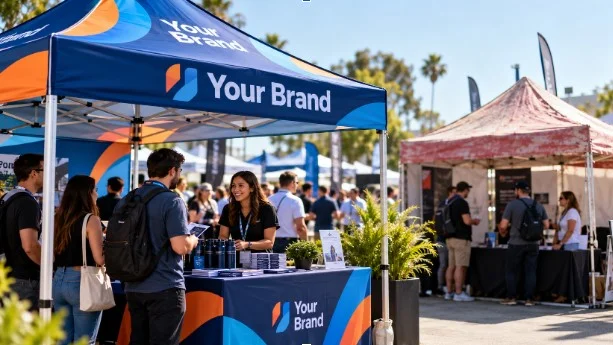
Imagine two booths across the aisle from each other. The same crowd, products, and show, but one canopy sports rich colors and clean print, while the other has seen too many years in the bed of a pickup and has taken on the look of something between pink and an apology. When it comes to explaining to the team why the attendees are walking past one booth and right up to the other, the spreadsheet that houses the cost per lead says it all — but the difference between the canopies is an input that most companies will only pay for once.
This guide shows how to quantify that difference: how to calculate the true cost of an event, what cheap equipment really costs you, and why a quality custom-printed canopy usually lowers your cost per lead over time rather than raising it.
Understanding How Canopy Quality Affects Event ROI
A canopy does two jobs at once. It shelters your team and your products, and it advertises your brand from across the hall. The first job is easy to see; the second is easy to forget when you are comparing prices. But on a busy show floor, the canopy is often the first thing an attendee sees — and the first thing they judge.
A faded, sagging or damaged canopy tells a story before anyone reaches your booth: that this company cuts corners, or does not care about details. A clean, bold, well-kept canopy tells the opposite story. Neither impression is fair as a judgement of the product inside, but both are real, and both affect how many people stop.
That is why canopy quality belongs in your event ROI calculation, not in a separate “branding” budget that nobody measures. It affects leads directly, and leads are what the rest of the event spend is for.
1. Calculate the True Cost of Every Event
When asked to name the cost of an event, most will rattle off the booth fee, but when it comes to the cost of a lead, explanations grow vague. The truth is that the real value of any lead must be measured across all costs associated with an event, which include travel, booth space, staff time, samples, and yes, even the setup being used.
The key point is that the setup does not depreciate from one show to the next in the way a booth fee does. It amortises over the life of the canopy. Something that lasts for forty shows only costs a fortieth of what is listed on the receipt at each new venue, but something that fails after five will still be a fifth of the number at every show it sees. That is the math few bother to track properly.
A practical way to do the calculation:
| Cost item | What to include |
|---|---|
| Booth and space | Booth fee, power, wifi, furniture hire |
| Travel and accommodation | Flights, hotels, mileage, meals for staff |
| Staff time | Hours on the floor, valued at loaded cost — not just expenses |
| Samples and giveaways | Product, print, shipping to the venue |
| Equipment share | Canopy and display cost divided by expected number of shows |
| Follow-up | Time and tools spent contacting leads after the event |
Add those up, then divide by the number of qualified leads captured — not everyone who took a flyer, but the people who are actually a fit and agreed to be contacted. That figure is your true cost per lead, and it is the only number that lets you compare events honestly.
2. Identify the Hidden Costs of Cheap Equipment
Low-cost canopies come with a few hidden costs, none of which will show up on the receipt. Chief among them is the lifespan of the gear itself. Thin fabric and cheap frames often require replacement after only a few events because they fail under the combined stress of weather and repeated setup.
The presentation of a failing canopy will also hurt the number, as potential leads will judge a company by the state of its booth — a fair judgement to make from ten feet away. A canopy that looks tired makes the whole booth look tired, and attendees who would have stopped walk on.
A less obvious expense is the loss of time. A jammed frame for one hour on the floor while crew members fight it out instead of tending to the attendees who should have been seen in that same hour is an hour of lost leads. None of these are recorded anywhere, but all add to the true cost of an “affordable” booth.
Other hidden costs worth tracking:
- Repairs and replacements — replacement fabric, broken frame parts, rush shipping before the next show.
- Setup delays — a canopy that takes three people and an hour to erect instead of two people and twenty minutes.
- Weather failures — a canopy that leaks, flaps or collapses in wind, forcing you to close the booth early.
- Reprinting — cheap print that fades after a season, so the canopy looks old long before the frame wears out.
Add even a conservative estimate for these, and the cheap canopy usually stops looking cheap.
3. Invest in Quality for Long-Term Value
A sturdy setup of custom tents will improve the math in both directions because it will last, reducing the slice that any one event must pay, and draw attention from a distance due to its bold, clean markings. This is where the value of printed canopies comes into its own because, at first glance, the math seems reversed: a company must pay more per canopy, but the benefits continue to stack up long term.
The cost per event drops over the life of the canopy as it sees multiple shows, and the cost per lead drops further because bold graphics are easier to read from a distance. A lead who can see the name of a booth is more likely to stop and speak, while a lead who can remember the company from their conversation and return the next year is getting value beyond either show’s launch week. The longer it lasts, the more value it provides, and the longer it is amortised across a company’s event budget.
What to look for in a quality canopy:
- Frame: aluminium or steel with solid joints, not thin tubing that bends on the second setup.
- Fabric: heavyweight, UV-resistant and water-resistant material with print that will not fade after a season in the sun.
- Print quality: crisp, high-resolution graphics in brand colours, readable from 10–20 metres.
- Ease of setup: a frame your team can erect quickly and reliably, ideally without tools.
- Warranty and parts: a supplier who stocks replacement parts and stands behind the frame.
4. Expand Your Event Presence Without Overspending
The main canopy is not the only piece of printed equipment that can serve as a lead generation tool, either, with smaller pieces of shade working well around the edges to hold overflow, samples, or tastings. A custom market umbrella is a perfect addition to any show space, as it shelters those inside while still displaying the brand name in large type from a distance. All without requiring the kind of extra booth space that few company budgets can justify.
Outdoors, a few well-placed pieces at the edges of the main canopy transform a sparse setup into a destination draw for those seeking shade. The same logic applies to branded flags, table covers and back walls: each one adds a visible brand surface for a fraction of the cost of more floor space. The goal is not to fill the booth with stuff, but to make the space you already have work harder — more shade, more branding, more reasons to stop.
5. Compare Costs and Leads Over Time
The math part is simple, really: leads captured per event, full costs, and the slice belonging to the canopy, then the same numbers from this year to last and the custom canopy to the cheap one. Companies that make this comparison find that they rarely return to low-quality canopies because the math speaks for itself. Quality gear does not add costs, but instead stretches them out over time and multiple leads while capturing value for itself, improving the cost per lead figures as time goes on.
A worked example makes the point:
| Cheap canopy | Quality canopy | |
|---|---|---|
| Purchase price | $300 | $1,200 |
| Shows before replacement | 5 | 40 |
| Cost per show | $60 | $30 |
| Leads per show (typical) | 40 | 55 |
| Canopy cost per lead | $1.50 | $0.55 |
The numbers are illustrative, and your own figures will differ — but the pattern is consistent: the canopy that costs four times as much upfront costs less per show and less per lead, because it lasts eight times longer and attracts more people. Add the hidden costs of the cheap option — a replacement, a repair, an hour of lost setup time — and the gap widens further.
Track the comparison properly: record leads, full costs and the canopy’s per-event share for every show, in the same spreadsheet, every time. After three or four shows you will have a real answer instead of a guess, and it will usually point the same way.
Caring for Your Canopy So It Lasts
A quality canopy is an investment, and a little care protects it. Dry the fabric fully before storage — packing it away damp is the fastest way to grow mould and ruin print. Clean it after dusty or wet shows with mild soap and water, and let it dry in the shade. Store frames and fabric separately where possible, keep the carry bag clean, and check joints and fasteners before each show rather than discovering a problem on the floor. A canopy treated this way will routinely last years longer than one that is stuffed away wet after every event.
The Bottom Line
The cost of a booth will always rise, travel will never get cheaper, and the battle for attention on the floor of any show will continue unabated, but the only piece of the puzzle that continues to be in the hands of the company is the canopy. Bought once and cared for, the quality piece will continue to see use at each event and provide a home for the crew to operate from, its costs amortised across the life of the equipment and its value continuing to grow. Focus on the value it brings to the floor of any show, and the arithmetic will take care of itself: more leads under the same canopy year after year, with costs dropping at each stop.
Frequently Asked Questions (FAQs)
How do I calculate cost per lead at an event?
Add up all event costs — booth, travel, staff time, samples, the canopy’s per-event share and follow-up — then divide by the number of qualified leads captured. That is your true cost per lead.
Why does a more expensive canopy lower cost per lead?
Because the cost is spread over many more shows: a $1,200 canopy lasting 40 shows costs $30 per show, while a $300 canopy lasting 5 shows costs $60 per show. The quality canopy also attracts more visitors, so the cost is divided across more leads.
How long should a quality canopy last?
With reasonable care — drying before storage, cleaning after wet or dusty shows, checking joints — a quality canopy commonly lasts for dozens of shows over several years, where a cheap one may fail after only a few events.
What makes a canopy’s print effective?
Bold, clean graphics in brand colours, readable from 10–20 metres, with the company name large enough to read at a glance. Faded or cluttered print does the opposite and can put attendees off.
Are smaller printed items like market umbrellas worth it?
Yes, when they add branded shade and visibility without requiring extra booth space. They work well at the edges of a main canopy for overflow, samples or tastings.
How should I store a canopy between events?
Dry the fabric fully, clean it with mild soap and water after dusty or wet shows, store fabric and frame separately where possible, and check joints and fasteners before each show.