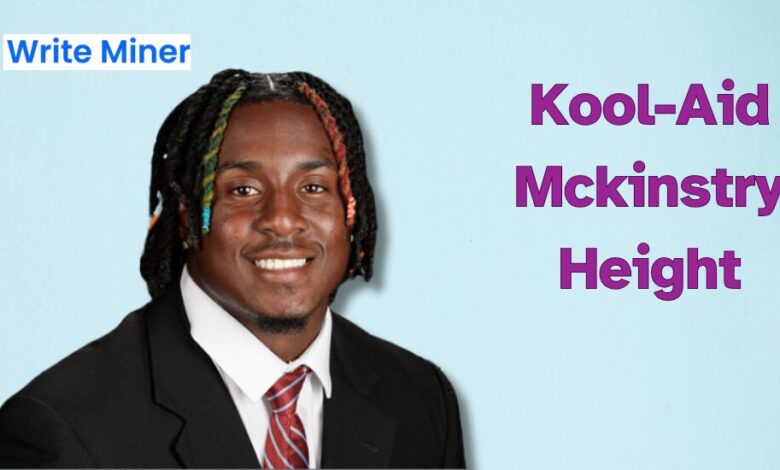
Kool-Aid McKinstry is about 5 feet 11 inches tall. At the 2024 NFL Scouting Combine he measured roughly 5-11½ (about 182 cm) and 199 pounds, and the New Orleans Saints list him at 5-11. Alabama’s college roster had him at 6-1, which is why taller figures still circulate online.
So which number is right? All three, in a sense — but they were produced in different ways, for different purposes, and only one of them was measured under controlled conditions in front of all 32 NFL teams. This guide puts every measurement in context: where each number comes from, which one to trust, how his size compares with other NFL cornerbacks, and what his arm length and hand size actually tell scouts. It also covers his path from Pinson Valley High School to Alabama and the Saints, including the foot injury that changed his draft night.
Kool-Aid McKinstry’s Measurements at a Glance
| Measurement | Figure | How it compares with NFL cornerbacks |
|---|---|---|
| Height (2024 combine) | About 5 ft 11½ in (182 cm) | Close to the position average |
| Weight (2024 combine) | About 199 lbs (90 kg) | On the heavier side for a corner |
| Arm length | About 32 in | Slightly above average |
| Hand size | About 8½ in | Small for the position |
| Alabama roster listing | 6 ft 1 in, about 195 lbs | College listings often run generous |
| Saints roster listing | 5-11, about 199 lbs | Rounded from the combine figure |
| Athletic testing | Did not test at the combine | Held out after a foot fracture was found |
Because he skipped the timed drills in Indianapolis, any 40-yard dash, vertical jump or shuttle time you see attached to his name should be treated as unofficial. His combine record consists of measurements only. If a profile site quotes a precise 40 time as if it were official, that is a good sign the page is guessing.
Why You See Three Different Heights for Him
McKinstry is a textbook example of a problem that affects almost every football player. There are three kinds of height figures in circulation, each measured in a different way and for a different purpose.
| Source | Height | How it is measured | Reliability |
|---|---|---|---|
| Alabama roster | 6-1 | Supplied by the school, sometimes in cleats, often rounded up and rarely updated | Low |
| NFL Scouting Combine | About 5-11½ | Barefoot, by league staff, to fractions of an inch, in front of all 32 teams | High |
| Saints roster | 5-11 | Team’s public listing, usually rounded from the combine figure | Good |
| Profile and fan sites | 6-0 (flat) | Unclear; appears to blend the college and combine numbers | Low |
The flat six feet that appears on many celebrity-style profile pages does not match any official source. It looks like a compromise between the college and combine numbers that then got copied from page to page. When two sources disagree, the combine measurement is the one to rely on, because it is the only figure taken under the same controlled conditions for every prospect.
His weight moved in the opposite direction. He measured a few pounds heavier than his Alabama listing, which is normal: prospects spend the months between their last college game and the combine in dedicated strength and conditioning programmes rather than playing a weekly schedule, so many arrive heavier than their roster weight.
How to Check His Current Listed Height Yourself
Open the New Orleans Saints’ official roster page and find his player card; it shows the team’s current listed height and weight. Compare it with his NFL.com player profile, which carries the league’s own listing. Treat any figure that disagrees with both as outdated or unsourced. Remember that listings can change slightly from year to year as teams re-weigh players in training camp.
That habit is worth building for any player, not just McKinstry. Roster pages are updated by teams; profile aggregators often are not. A number that has sat unchanged on a fan site since 2023 tells you nothing about what a team lists today.
Is 5-11 Tall Enough for an NFL Cornerback?
Yes. Most NFL cornerbacks fall between about 5-9 and 6-2, and McKinstry sits in the middle of that range. Height works more like a threshold than a sliding scale at the position. A corner who is too short struggles to contest high throws against big receivers; one who is very tall can find it harder to flip his hips and change direction against quick slot players. Once a player clears the threshold, technique, recovery speed and ball skills matter far more than another inch.
| Cornerback | Approximate listed height | Takeaway |
|---|---|---|
| Sauce Gardner | 6-3 | Rare length for the position |
| Patrick Surtain II | 6-2 | Prototype size for a press corner |
| Kool-Aid McKinstry | 5-11 | Average height, solid frame and arm length |
| Devon Witherspoon | 5-11 | Similar height, drafted in the top five |
The comparison makes the point: corners of very different heights have become high picks and quality starters. McKinstry’s frame, close to 200 pounds, is arguably more relevant to his role than his height, because it helps him tackle in run support and hold his ground against bigger receivers in press coverage.
Strengths and Limits of His Build
| Trait | What it helps with | Where it can be tested |
|---|---|---|
| Average height | Mirroring quicker receivers, changing direction | Jump balls against 6-3 and taller wideouts |
| Near-200-lb frame | Press coverage, tackling, holding up over a full season | Rarely a disadvantage for a boundary corner |
| About 32-in arms | Jamming at the line, reaching the catch point late | Plays above average for his height |
| About 8½-in hands | Pass breakups still come from timing and position | Finishing contested catches as interceptions |
The pattern is clear: his build is well suited to the boundary corner role the Saints ask him to play. He is not the longest corner in the league, and he is not the tallest, but he is strong enough to survive the physical parts of the job and long enough to contest throws that a shorter corner could not reach.
Arm Length and Hand Size: The Numbers Scouts Watch
Scouts often care more about arm length than standing height, because long arms let a corner jam receivers at the line and reach the ball at the catch point. McKinstry’s arms measured around 32 inches, a touch above the typical cornerback figure, so effective length is not a weakness for him. In practical terms, he plays a little bigger than his listed height when he is in position.
His hands, at roughly 8½ inches, are the measurement that stands out on the small side. Hand size is loosely linked to how often a defender turns pass breakups into interceptions and how well he can rip the ball away in contested situations. It is not destiny, and plenty of corners with small hands catch well, but it is a reasonable explanation for why his reputation has been built more on breaking up passes than on big interception totals.
Taken together, the measurables describe a player whose value comes from positioning and timing rather than from rare physical gifts. That is consistent with everything else in his career: he was a five-star recruit because of his instincts and technique, not because he was the biggest athlete on the field.
Quick Facts About Kool-Aid McKinstry
| Detail | Information |
|---|---|
| Given name | Ga’Quincy McKinstry |
| Nickname | Kool-Aid |
| Hometown | Birmingham, Alabama area |
| High school | Pinson Valley High School, Pinson, Alabama |
| College | University of Alabama (2021 to 2023) |
| Position | Cornerback; also returned punts in college |
| NFL draft | 2024, second round, 41st overall, New Orleans Saints |
| Recruiting profile | Five-star prospect, one of the top cornerbacks in the 2021 class |
Profile sites disagree about his exact date of birth, so for his current age the Saints’ official roster page is the most reliable reference.
Where the Nickname Kool-Aid Came From
Kool-Aid is a childhood family nickname. The most common explanation links it to a big, wide smile that reminded relatives of the Kool-Aid Man, though the details vary between interviews and there is no single confirmed version. What is clear is that it stuck early. By high school, recruiting analysts, broadcasters and fans were all using it, and it is now so established that many fans do not know his given name is Ga’Quincy.
The nickname has become a genuine part of his brand. It is memorable, it is positive, and it sets him apart in a league where most players are known by their surnames. It also means that anyone searching for his height is likely to search for “Kool-Aid” rather than “Ga’Quincy McKinstry” — one more reason the same few numbers get copied around the internet.
From Pinson Valley to Alabama
McKinstry starred at Pinson Valley High School outside Birmingham, playing on both sides of the ball. Time at receiver helped him understand route concepts from the offensive side, which is valuable for a cornerback trying to read what a receiver is about to do. He was also a talented basketball player, and the lateral movement, footwork and timing that basketball demands translate well to playing corner.
Rated a five-star recruit, he stayed in state and signed with Alabama, a programme with a long record of sending defensive backs to the NFL. Football pipelines like that often run through families and regions as much as schools, a theme explored in our profile of the Watt brothers.
His Alabama Years
- 2021: Played right away as a freshman, a notable achievement in Alabama’s deep secondary, and began handling punt returns.
- 2022: Became a full-time starter and one of the SEC’s most dangerous punt returners, earning All-America recognition.
- 2023: Added more All-America and All-SEC honours as a shutdown corner. Quarterbacks often threw away from him, which kept his raw statistics modest. He declared for the draft after the season.
That last point matters when you read his college stat lines. A corner who is rarely targeted will not pile up interceptions, and evaluators look at targets allowed and completion rate against him rather than totals alone. A quiet stat sheet can be the best compliment a cornerback ever gets.
The Combine Foot Injury and the Draft Slide
McKinstry entered the 2024 pre-draft process with plenty of first-round buzz. During the combine medical exams, doctors found a Jones fracture in his right foot, a break near the base of the fifth metatarsal that athletes and trainers take seriously because it can heal slowly and sometimes recurs. He did not do any athletic testing and had the foot addressed surgically. Recovery from that kind of injury typically involves a structured rehab plan over several months, similar to the process described in our guide to orthopedic and sports physiotherapy injury management.
Without timed speed numbers and with a foot injury on his medical file, he slipped out of the first round. The Saints traded up with the Green Bay Packers to take him 41st overall. For the player, the difference is meaningful: first-round contracts are larger and include a fifth-year team option, while second-round deals are smaller and run four years. Estimates put his rookie contract somewhere in the high single-digit millions over four seasons, though exact figures vary by source and should be treated as estimates, not fact.
The slide says less about his talent than about how the draft works. Teams are buying four years of a player at a price set by the round, and an unanswered medical question is one of the few things that can move a player down a board overnight. The Saints clearly decided the value at 41st overall was worth the risk — and they were willing to trade up to get him.
His NFL Career with the Saints
McKinstry began his rookie year in 2024 as a rotational corner behind veteran Marshon Lattimore. In November 2024, New Orleans traded Lattimore to the Washington Commanders, which opened a starting job, and McKinstry spent much of the rest of the season in the lineup. The 2025 season was his first full year as an established starter, and he took a clear step forward in coverage, pass breakups and tackling.
Season statistics change every week and are often out of date on aggregator sites, so for current numbers check the Saints’ official site or the NFL’s player pages. Those are also the best places to confirm his latest listed height and weight.
Looking ahead, his rookie contract runs through the 2027 season. A cornerback who holds a starting job through a first deal is typically in line for a much bigger second contract, which is where most players’ real earning power arrives. Family and career stories around NFL players draw a lot of interest; if you enjoy that side of the sport, see our piece on Dak Prescott’s brother.
What His Measurables Do and Do Not Tell You
Height, weight, arm length and hand size are useful inputs, but they are not a forecast. Every draft class produces cornerbacks who measured perfectly and never started, and others who were called undersized and became stars. The traits that separate good corners, such as reading route combinations early, staying attached through a receiver’s break and playing the ball at the right moment, do not show up on a measurement sheet.
McKinstry’s story also shows how quickly a number becomes accepted as fact online. The flat six-foot height he was never officially measured at is everywhere, while the more useful details (an average height, a sturdy frame, solid arm length and small hands) get far less attention. What made him a five-star recruit and a high draft pick was his instincts and technique, not an extra inch.
Common Mistakes When Reading Player Heights
- Treating a college roster listing as a measurement; it is a school’s own figure and often generous.
- Assuming a profile site’s number is current; many copy each other and never update.
- Comparing heights across sources measured in different ways, such as in cleats versus barefoot.
- Ignoring arm length, which often matters more for a corner than standing height.
- Quoting a 40-yard dash time for a player who never ran one at the combine.
The Bottom Line on Kool-Aid McKinstry’s Height
If you need one number, use about 5-11½ from the 2024 combine, or 5-11 as the Saints list it. Treat the 6-1 college figure and the flat 6-0 seen on profile sites as outdated or unsourced. For a cornerback, his roughly 32-inch arms and near-200-pound frame say more about how he plays than his height does, and his production with the Saints is the best measure of all.
Frequently Asked Questions (FAQs)
How tall is Kool-Aid McKinstry?
He measured about 5 feet 11½ inches (roughly 182 cm) at the 2024 NFL Scouting Combine, and the Saints list him at 5-11. Alabama listed him at 6-1 in college, which is why some sites still show a taller figure.
How much does Kool-Aid McKinstry weigh?
He weighed about 199 pounds at the 2024 combine, a few pounds more than his Alabama listing. Check the Saints’ official roster for his current listed weight, since teams update it from season to season.
Is Kool-Aid McKinstry 6 feet tall?
No official source lists him at exactly 6 feet. His combine measurement was about 5-11½, his NFL listing is 5-11, and his college listing was 6-1; the flat 6-0 figure seen online appears to be a blend of those numbers.
What is Kool-Aid McKinstry’s real name?
His given name is Ga’Quincy McKinstry. Kool-Aid is a childhood family nickname, usually linked to his wide smile, and it followed him through high school, college and the NFL.
Why didn’t he run the 40-yard dash at the combine?
Doctors found a Jones fracture in his right foot during combine medical checks, so he skipped athletic testing and had the foot treated surgically. Any 40 time published for him is unofficial.
Which team drafted Kool-Aid McKinstry?
The New Orleans Saints traded up with the Green Bay Packers to select him 41st overall in the second round of the 2024 NFL Draft.


